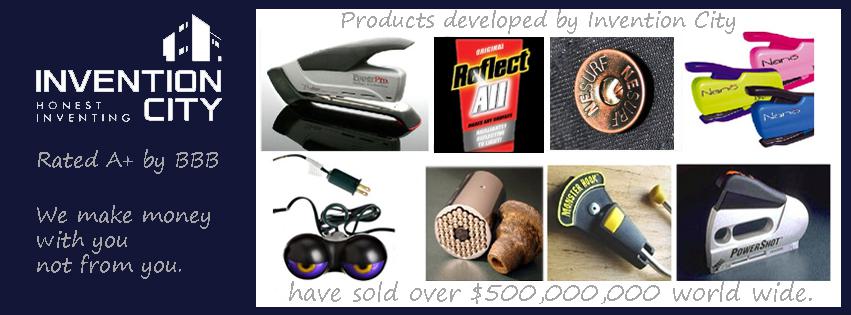
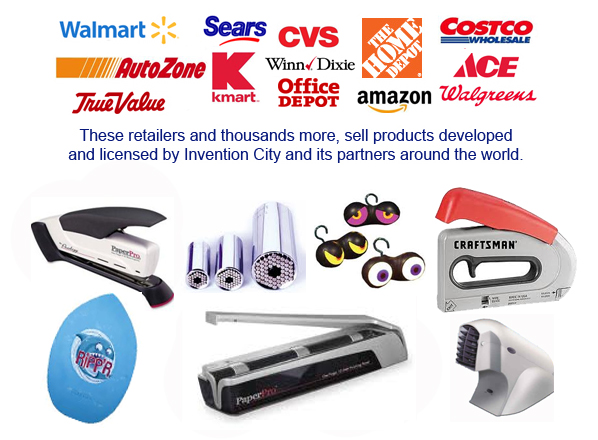
Products created and commercialized by Invention City and its partners have generated over $500,000,000 in retail sales and tens of millions in royalty income. We are actively looking to license new inventions in all categories and all stages of development. When we say "yes" we offer to do it all and pay for everything so that you risk nothing more - we take responsibility for patents, prototypes, engineering, design and marketing, to turn your new invention idea into a manufactured product with a real opportunity for market success. The first step to working with us is our Brutally Honest Review. Click to see the video and read our fine print in bold.
Starting as garage inventors we've had over 25 years of experience creating, developing, licensing and selling inventions to Fortune 100 corporations and start-up companies. This gives us deep first hand knowledge of prior art research, market evaluation, building prototypes, engineering for manufacturing, industrial design, writing and filing US and international patents and trademarks, defending patents and trademarks in the US and internationally, negotiating licensing agreements, managing licensing relationships, sourcing and managing manufacturing and fulfillment, marketing via traditional distribution to mass merchants, chains, individual retailers, direct marketing via DRTV, internet and crowd funding, forming strategic partnerships and launching and selling start-up companies. We don't know of anyone in our industry who's had our breadth and depth of experience. We've enjoyed a lot of success and have learned from failures too. Learn more about us here.
Over the years we've heard from inventors who've wasted thousands, tens of thousands and even hundreds of thousands of dollars pursuing their dreams and failing. Invention City's mission is to help inventors keep money in their pockets, increase their chances of success and commercialize great new product ideas through licensing and partnership deals. The Invention City team is comprised of successful inventors and entrepreneurs who've made their money by bringing new patented products to market. We want to make money with you, not from you. Read about us here .
Lies don't fly.
Choosing Invention City
The difference between Invention City and other invention companies is the success, depth and unique experiences of the Invention City team along with a business model that's structured to profit with inventors rather than from them. Invention City grew out of WorkTools, Inc., (read about WorkTools here.) We come at this business having been bona fide garage inventors and that's where our hearts remain. These links explain:
We believe that inventors should do as much as they can on their own and then, when informed and ready, seek help and advice from providers who genuinely care. Our Brutally Honest Review is a great way to get professional feedback and a real chance for success. A visit to the info booth is a good way to get started. Be careful about disclosing proprietary and confidential information to anyone. We hope that your visit is productive. Please visit us often and let us know how we can make things better.
Invention City provides inventors and new product idea developers with information, resources and help for each stage of the inventing process. Use the links above to learn how to:
Gator-Grip patents have expired. That's why so many knockoffs exist today.If your invention idea is successful it will be copied. That's a simple fact that every inventor must face. Patents, trademarks and copyright (collectively known as intellectual property or IP) are tools you can use to fight the copies. But how do they actually work?The #1 thing to know is that you have to enforce IP on your own. The government doesn't do it for you. It is up to you to inform the infringer that they are infringing and then either negotiate a settlement or sue them in ...
Make a dartboard out of rejection letters. It was 35 years ago but I'm still elevated about the rejection letter we got from the tool reviewer at the Whole Earth Catalog. Our product, the SqueezeDriver, seemed like a perfect fit. Whole Earth was a crunchy granola pro-environment publication and the SqueezeDriver was mechanical and wouldn't add toxic battery waste to the earth. It also gave you a feel for what you were doing, great for precision work where you don't want to strip screws. We'd sent the tool reviewer a sample and he responded with a letter. A long letter ...
Licensing deals are rare. When they happen, the process can sometimes take up to a year. However, sometimes things go fast. Before you make a first phone call to a licensing prospect, know what "yes" means for you.One of the first things a prospective licensee will ask is a test question: what are you looking for? If your answer is unrealistic (for them), they'll walk away in an instant. You may get the chance to say "only kidding," but maybe not. The best way to know what "yes" should be is to take a hard look at your alternatives. If ...
DALL-E image from prompt: "create an image of an AI powered social media platform" AI is poised to upend the world in ways we can barely imagine. Work, relationships, health care, law, government, military... Every aspect of our lives will be affected in some manner. Think about how the Internet has changed things and multiply by, I don't know (nobody knows), something, let's say 10. You can quote me: Mike Marks says that, "AI will be 10X bigger than the Internet."The multiplier is meaningless. But the point is not. So far we've been tickled by fun toys like Chat GPT ...
Most all of us can handle the truth. But sometimes it takes time to digest. And what we believe is true can change when additional information becomes available. A core value at Invention City is telling inventors what we believe is true. Often that means saying an invention does not look like a good licensing opportunity to us, based on the information available at this time. What's critical in that statement is that new information can change our opinion.Last year a young mom on a tight budget submitted an idea to us that, at first glance, I thought was terrible ...