AI Solves a Math Problem That Stumped Mathematicians for 80 Years - And Inventors Already Know The Trick
The Breakthrough
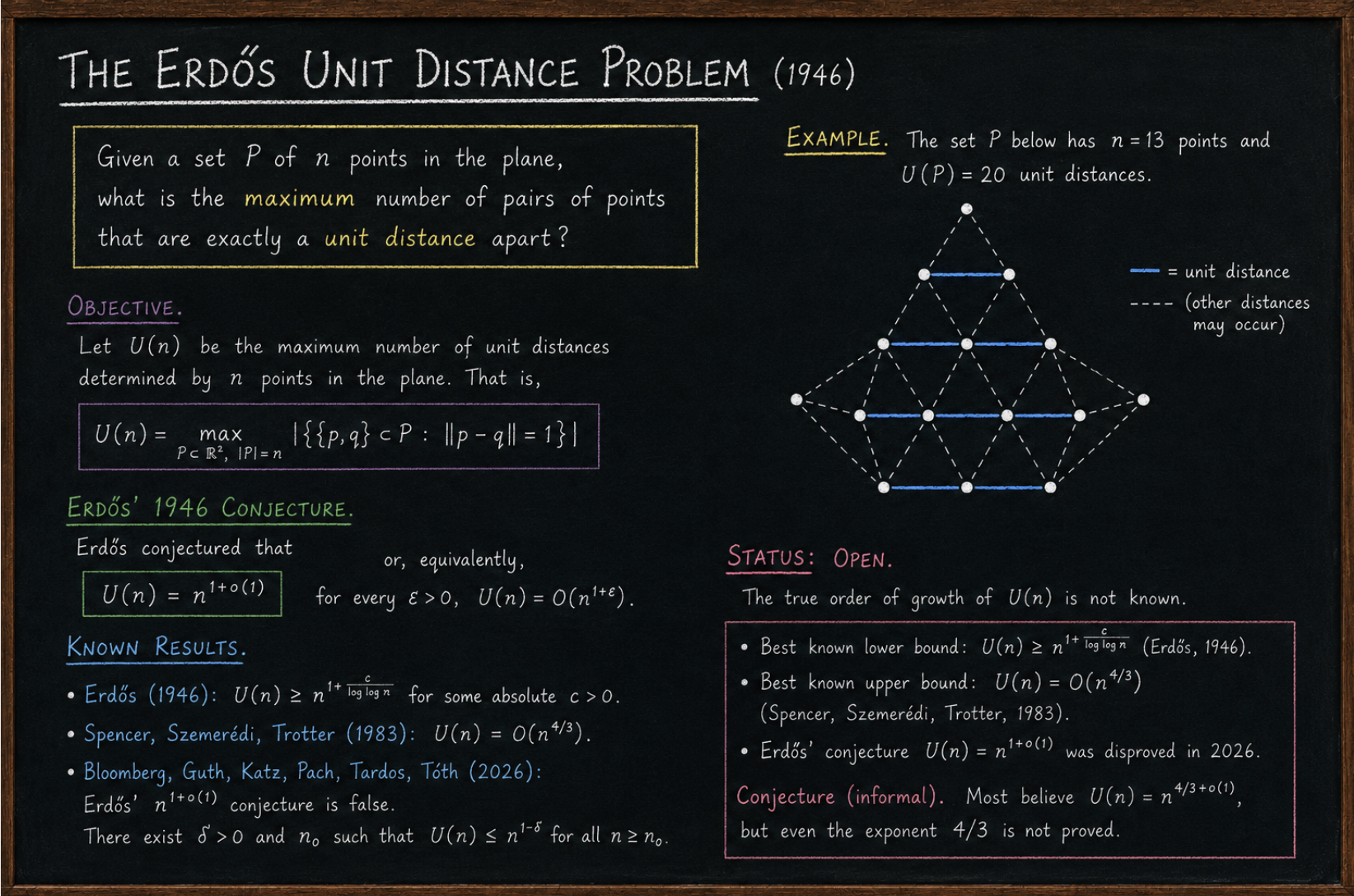
OpenAI just did something that stumped the world's best mathematicians for nearly a century. It solved - actually, disproved - a famous puzzle called the unit distance problem, posed in 1946 by Paul Erdős, the most prolific mathematician in history.
The problem: if you place n dots on a page, how many pairs can be exactly one unit apart? Erdős showed that a grid arrangement produced a certain number of pairs, and everyone assumed you couldn't do much better. For 80 years, mathematicians tried to prove him right.
Rather than trying to prove him right, the AI proved him wrong. It looked in the opposite direction by refusing to accept the premise everyone else started from.
Why Did AI Succeed Where Humans Failed?
Three reasons, and every one of them should sound familiar to inventors:
1. It rejected conventional wisdom. Every human who tackled this problem tried to confirm Erdős's conjecture. The AI didn't inherit that assumption. It experimented with strategies humans had dismissed as improbable - and found the path everyone else had walked past.
2. It synthesized across disciplines. Human mathematicians specialize. This solution required combining algebraic number theory and discrete geometry - two fields with about as much in common as the marathon and pole vault. The AI didn't know it wasn't supposed to mix them.
3. It didn't quit when the approach got uncomfortable. As OpenAI researcher Mark Sellke described it: "It's the kind of idea that you try for a bit, it doesn't work, and you think maybe you were just too hopeful. So you give up and move on." AI doesn't move on. It kept working a path that any reasonable human would have abandoned.
Inventors Know This Move
Here's the thing: independent inventors have been doing exactly this forever.
The AI's breakthrough wasn't raw computing power. It was creative inversion - looking at a problem everyone was solving one way, and asking what happens if you flip the assumption.
The PowerShot story is a fine example of this.
For 50+ years, every staple gun on the market put the hinge at the front and the handle at the back. You squeezed with your fingers. That was just... how staple guns worked. Decades of refinement, all built on the same premise.
Joel Marks rejected the premise.
Move the pivot point. Put the handle at the front. Now when you drive the tool, your entire arm drives it — not just your fingers. Suddenly a task that required difficult squeezing became easier with added arm power. The PowerShot was licensed by Black & Decker and became one of the best-selling staple guns in history, won the IDSA Design of the Decade Gold Award alongside the iMac and VW’s New Beetle.
Same problem. Inverted assumption. Completely different - and better - result.
The Inventor's Takeaway
When you're stuck on a problem, the most productive question isn't "how do I make this approach work better?"
It's: "What is everyone assuming that might not be true?"
The AI found a better arrangement of dots because it didn't inherit 80 years of mathematical conviction. Joel Marks found a better staple gun because he didn't accept 50 years of mechanical convention.
The math is different. The creative move is identical.
That move - assumption inversion — is one of the most powerful tools in an inventor's kit. AI is just now learning what good inventors have always known: sometimes the biggest breakthroughs come not from solving the problem in front of you, but from questioning whether you're solving the right problem at all.
Invention City can help you think about your idea differently. Contact us for help in moving your invention idea forward in a new direction.
share this article: facebook