You’ve done your homework, you want full control, and you are committed to taking your invention forward.
With our inventing services, the financial investment is your responsibility. and you maintain 100% control of everything from product development to commercialization.
Licensing is the easiest path to profit: get paid while others turn your idea into a product and manage the day-to-day grind.
With licensing, someone else is the invests in your idea and maintains control. Our Brutally Honest Review is a smart and honest way to start your licensing journey.
Our extensive library of invention resources has been developed over more than 20 years to help inventors make great decisions.
Browse our Resource Library for Inventors and build your knowledge about everything from NDA's & confidentiality agreements to patents, licensing, manufacturing and more.
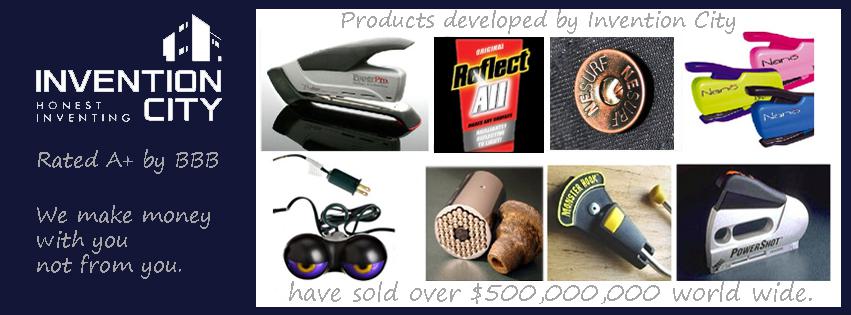
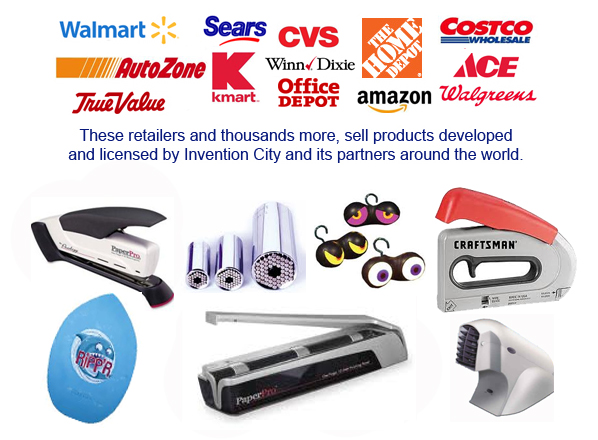
Products created and commercialized by Invention City and its partners have generated over $500,000,000 in retail sales and tens of millions in royalty income. We are actively looking to license new inventions in all categories and all stages of development. When we say "yes" we offer to do it all and pay for everything so that you risk nothing more - we take responsibility for patents, prototypes, engineering, design and marketing, to turn your new invention idea into a manufactured product with a real opportunity for market success. The first step to working with us is our Brutally Honest Review. Click to see the video and read our fine print in bold.
Starting as garage inventors we've had over 25 years of experience creating, developing, licensing and selling inventions to Fortune 100 corporations and start-up companies. This gives us deep first hand knowledge of prior art research, market evaluation, building prototypes, engineering for manufacturing, industrial design, writing and filing US and international patents and trademarks, defending patents and trademarks in the US and internationally, negotiating licensing agreements, managing licensing relationships, sourcing and managing manufacturing and fulfillment, marketing via traditional distribution to mass merchants, chains, individual retailers, direct marketing via DRTV, internet and crowd funding, forming strategic partnerships and launching and selling start-up companies. We don't know of anyone in our industry who's had our breadth and depth of experience. We've enjoyed a lot of success and have learned from failures too. Learn more about us here.
Over the years we've heard from inventors who've wasted thousands, tens of thousands and even hundreds of thousands of dollars pursuing their dreams and failing. Invention City's mission is to help inventors keep money in their pockets, increase their chances of success and commercialize great new product ideas through licensing and partnership deals. The Invention City team is comprised of successful inventors and entrepreneurs who've made their money by bringing new patented products to market. We want to make money with you, not from you. Read about us here .
Lies don't fly.
Choosing Invention City
The difference between Invention City and other invention companies is the success, depth and unique experiences of the Invention City team along with a business model that's structured to profit with inventors rather than from them. Invention City grew out of WorkTools, Inc., (read about WorkTools here.) We come at this business having been bona fide garage inventors and that's where our hearts remain. These links explain:
We believe that inventors should do as much as they can on their own and then, when informed and ready, seek help and advice from providers who genuinely care. Our Brutally Honest Review is a great way to get professional feedback and a real chance for success. A visit to the info booth is a good way to get started. Be careful about disclosing proprietary and confidential information to anyone. We hope that your visit is productive. Please visit us often and let us know how we can make things better.
Invention City provides inventors and new product idea developers with information, resources and help for each stage of the inventing process. Use the links above to learn how to:
The big risk is not public disclosure - it’s future discovery AI Chats, Patent Risk, and Routine Deletion Inventors are increasingly using AI tools such as ChatGPT, Claude, Gemini, Grok, and Perplexity to brainstorm, research, refine concepts, draft patent disclosures, and evaluate product ideas. That raises an obvious question: Can discussing an invention with AI jeopardize future patent rights? The answer is less clear than many people assume. My current understanding is that ordinary private chats with mainstream AI services are generally not treated the same way as publishing information on a website, presenting at a conference, or posting on ...
Hotel beds slope the wrong way A road tripper's field report on America's sagging hospitality (the solution has been invented). I just finished seven nights on the road - Best Westerns, Days Inns, Hampton Inns, the usual chain-hotel parade. The rooms were clean, the showers were hot, and the breakfast rooms all featured the modern symbol of American hospitality: waffle irons. At some point in the last decade, fresh waffles became standard in chain hotels. This is one of civilization's quieter achievements. A hot waffle at 7:00 a.m. before a long day of driving is good. But the beds. Five ...
AI solved this by _disproving_ rather than proving.The Breakthrough OpenAI just did something that stumped the world's best mathematicians for nearly a century. It solved - actually, disproved - a famous puzzle called the unit distance problem, posed in 1946 by Paul Erdős, the most prolific mathematician in history. The problem: if you place n dots on a page, how many pairs can be exactly one unit apart? Erdős showed that a grid arrangement produced a certain number of pairs, and everyone assumed you couldn't do much better. For 80 years, mathematicians tried to prove him right. Rather than trying ...
Some inventions make you wonder: why didn’t this exist already? CLIPWALK™ is one of them. Now it's available at Walmart.com Some inventions make you wonder: why didn’t this exist already?ClipWalk is one of them. Inventor Heather Sinclair spotted a simple, unsolved problem — dog owners needed a fast, reliable way to go hands-free with a retractable leash. Whether stopping at a café, sitting on a park bench, or just needing both hands, the existing options weren’t good enough. The answer turned out to be simple — it just needed the right person to see it. “The patent-pending design lets you ...
Engine mount needed to be replaced Spring has a way of reminding you about maintenance. For me, that reminder comes in the form of a 40-year-old, 25-foot sailboat. Every season starts the same way—oil changes, zinc replacements, hull work—and then there’s always one bigger project waiting. This year, it was the engine mounts. On paper, the job was simple: remove and replace 8 bolts, 4 nuts, and 4 grub screws. With perfect access, it’s a 30-minute task. In reality, it took me 6 hours. The reason wasn’t complexity. It was access. The Problem Most Inventors Don’t Design For The engine ...